Women 40+ / Menopause
Yoga + Strength Training
Why yoga and strength training belong together for women over 40 – especially through perimenopause, menopause, and beyond.
Midlife can change the way your body responds to sleep, stress, recovery, and exercise. You may notice that the workouts that once felt easy now leave you depleted, or that stretching alone no longer gives you the strength and stability you want.
This does not mean your body is failing. It means your training needs a smarter strategy.
Yoga and strength training are often treated as opposites: one calm and flexible, the other intense and muscular. In reality, they can be powerful partners. Strength training gives your muscles, bones, and nervous system a reason to adapt. Yoga helps you move with control, breathe under pressure, and stay connected to your body.
Together, they support something more meaningful than a number on the scale: the ability to feel capable in your daily life.
You do not have to choose between feeling strong and feeling calm. A thoughtful program can train both.
A practical, evidence-informed guide for women navigating midlife.
What strength training gives you
Strength training protects what midlife can quietly take away
The menopause transition can coincide with changes in muscle, bone, and body composition. Progressive resistance training is one of the most direct ways to push back against loss of strength and function.
1 Muscle that supports real life
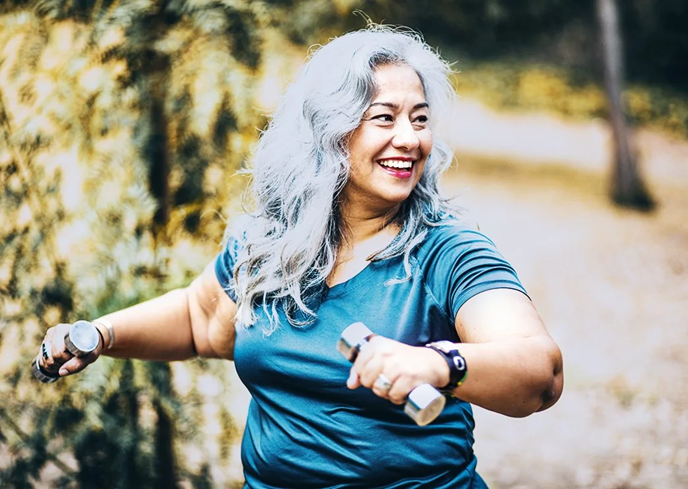
Getting stronger makes everyday tasks easier: carrying groceries, climbing stairs, lifting luggage, getting up from the floor, or keeping up with the people you love. Research in postmenopausal women consistently shows improvements in upper- and lower-body strength with resistance training.
2 A stronger signal for your bones
Bones respond to loading, but results depend on the kind of program, the intensity, and how long you train. Some studies show improvements in bone mineral density; others do not. The practical lesson is not that any light workout will “build bone,” but that progressive, well-designed strength work can be an important part of a bone-health plan.
3 Better function and confidence
Strength is also a form of independence. As your capacity improves, movements that once felt uncertain become more manageable. That confidence can carry beyond the gym.
The goal is not to punish your body. It is to give your body a clear, progressive reason to become more capable.
What “progressive” really means
Progress does not require lifting the heaviest possible weight. It means gradually asking a little more of your body while keeping good technique. Over time, you might:
- add a small amount of weight;
- complete one or two more repetitions;
- improve your range of motion;
- use better control and less momentum; or
- move to a slightly more challenging exercise variation.
What it does not promise
Strength training is valuable, but it is not a guaranteed cure for hot flashes, weight gain, or every menopause symptom. Reviews suggest possible benefits in several areas, yet the certainty of symptom-specific evidence is still limited. Your program should be judged by the changes you can measure: strength, function, energy, confidence, and consistency.
What yoga adds
Yoga makes consistency easier by supporting mobility and recovery
Yoga is more than stretching. Depending on the style, it can train balance, body awareness, controlled strength, breathing, and the ability to settle your nervous system.
Mobility you can use
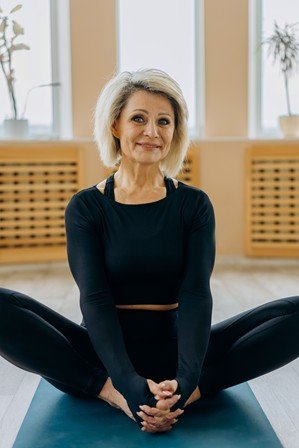
Useful mobility is the ability to move through a comfortable range while staying in control. Yoga can help you explore positions slowly, notice restrictions, and improve coordination. That can complement strength work, especially if stiffness makes squats, hinges, presses, or overhead movements feel awkward.
Balance and body awareness
Standing poses and transitions ask you to organize your feet, hips, trunk, and gaze. This does not replace progressive strength training, but it can sharpen the control that makes daily movement feel steadier.
A practice for downshifting
Breath-led movement can create a deliberate pause in a demanding week. A recent systematic review found that yoga improved overall menopause symptom scores, sleep quality, anxiety, and depressive symptoms across the included trials. Importantly, the same review did not find a significant difference for hot flashes or overall quality of life. Yoga can help, but it should not be sold as a cure-all.
Choose the practice for the day you are having
On a high-energy day: a more active flow may feel good.
On a recovery day: slower poses, supported positions, and gentle breathing may be a better fit.
When balance feels off: practice near a wall or stable support.
When joints are sensitive: shorten the range, use props, and avoid forcing a shape.
Yoga should help you listen to your body – not pressure you to perform flexibility.
Yoga is a complement, not a substitute
Yoga can create muscular effort, and some poses are challenging. But for most women, it is difficult to progress the load as precisely as you can with dumbbells, machines, bands, or barbells. If maintaining muscle, strength, and bone is the goal, keep dedicated resistance training in the plan.
Why the combination works
The combination covers more than one outcome
Strength training and yoga do not need to compete for your time. They answer different questions, and that is exactly why they pair well.
It builds a measurable progression in muscular strength and functional capacity.
It supports mobility, balance, awareness, and recovery.
One practice builds capacity; the other can help you access and sustain it. This is a coaching rationale, not a claim that every combined program has been proven superior in a head-to-head trial. The best plan is the one that matches your goals, health history, symptoms, schedule, and current training experience.
You do not need a perfect week. You need a repeatable one.
A simple starting framework
| SESSION | PURPOSE | EXAMPLE FOCUS |
|---|---|---|
| Strength AFull body | Practice the major movement patterns with good control. | Squat or sit-to-stand, row, hip hinge, press, carry. |
| Yoga A20–30 minutes | Restore comfortable movement and reduce tension. | Gentle flow, hip and upper-back mobility, breathing. |
| Strength BFull body | Repeat key patterns and progress gradually. | Step-up, pulldown or band pull, bridge, press, core stability. |
| Yoga B20–30 minutes | Build balance, awareness, and recovery. | Standing poses, supported balance, slower floor work. |
General adult guidance recommends muscle-strengthening work for all major muscle groups on at least two days each week. Your own starting point may be different.
How to make it yours
Train for the next decade, not the next weigh-in
A strong midlife plan is not built around fear, punishment, or chasing the body you had at 25. It is built around the life you want to keep living.
Start below your maximum
Leave room to learn. Your first weeks should help you find repeatable weights, comfortable ranges, and a rhythm you can recover from.
Measure what matters
Notice whether you can lift more with good form, climb stairs with less effort, hold balance longer, sleep more consistently, or move through your day with more energy. These wins tell a richer story than the scale alone.
Let symptoms inform the plan
Poor sleep, pain, fatigue, or heavy stress may change what a productive session looks like. Adjusting is not quitting. It is skilled training.
Build support around the work
Recovery still matters: nourishing meals, adequate protein, hydration, regular walking or aerobic activity, and sleep routines all contribute to the bigger picture.
When to get individualized guidance
Speak with a qualified healthcare professional or appropriately credentialed trainer before starting or changing your program if you have osteoporosis, a history of fracture, pelvic-floor symptoms, significant joint pain, dizziness, uncontrolled blood pressure, a recent surgery, or another condition that may affect exercise. Stop and seek medical care for chest pain, fainting, or unusual severe symptoms.
Your strongest chapter can begin now
Two strength sessions. Two short yoga practices. Small progressions. Honest recovery. That is enough to build momentum – and momentum is what turns exercise into a way of living.
Evidence and further reading
Sources
This article uses adult activity guidance and systematic reviews focused on yoga, resistance training, muscle, and bone outcomes in midlife and postmenopausal women.
How to read the evidence
Exercise research is not a promise that every person will experience the same result. Programs vary in duration, intensity, supervision, and participant health. That is why the article distinguishes consistent findings – such as improved strength – from areas where results remain mixed, such as the exact effect of every program on bone density or individual menopause symptoms.
- World Health Organization. Physical activity recommendations for adults. https://www.who.int/initiatives/behealthy/physical-activity
- “The effectiveness of yoga on menopausal symptoms: A systematic review and meta-analysis of randomized controlled trials.” PubMed. https://pubmed.ncbi.nlm.nih.gov/39467491/
- “Resistance training effects on healthy postmenopausal women: a systematic review with meta-analysis.” PubMed. https://pubmed.ncbi.nlm.nih.gov/38353251/
- “Does exercising during peri- or early post-menopause prevent bone and muscle loss: A systematic review.” PubMed. https://pubmed.ncbi.nlm.nih.gov/40967555/
- “Optimal resistance training parameters for improving bone mineral density in postmenopausal women.” PubMed. https://pubmed.ncbi.nlm.nih.gov/40420105/
- “Effectiveness of Pilates and Yoga to improve bone density in adult women.” PLOS ONE. https://journals.plos.org/plosone/article?id=10.1371%2Fjournal.pone.0251391